

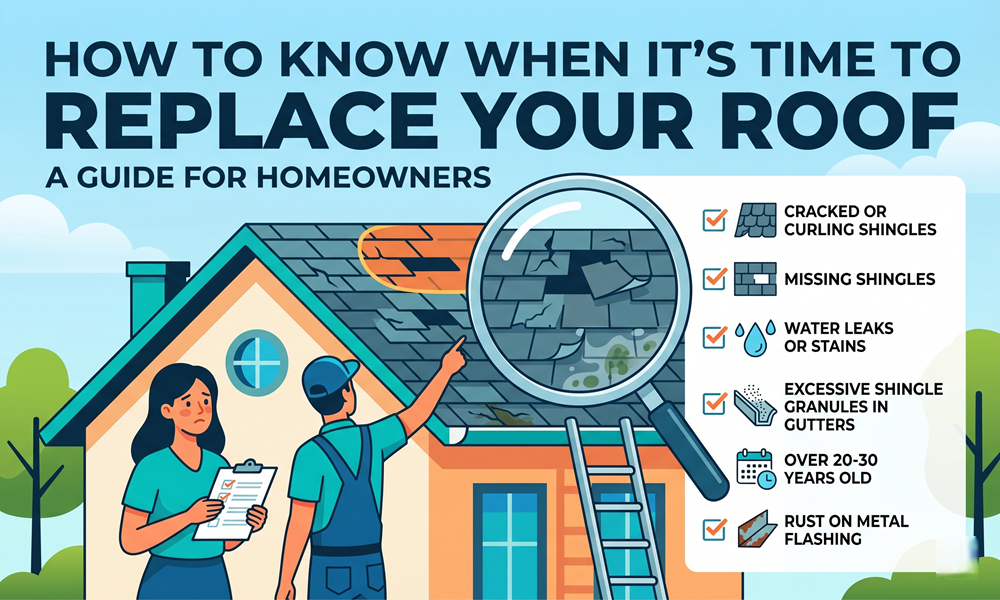
Your roof does not announce its failures loudly. It signals them slowly, through water stains on the ceiling, missing shingles after a storm, or a utility bill that keeps climbing without explanation. The question most homeowners wrestle with is whether they are dealing with a fixable problem or a roof that has simply run its course. Getting that wrong in either direction costs money, and the difference between a patch job and a full replacement is not always obvious without knowing what to look for.
This guide walks you through the clearest indicators that your roof needs replacement rather than repair, so you can make an informed decision before a small problem becomes a structural one.
Age Is the Starting Point, Not the Whole Picture
Most asphalt shingle roofs are designed to last between 20 and 25 years under normal conditions. If your roof is approaching or past that range, even a relatively minor issue is worth evaluating more seriously. A repair on a 22-year-old roof buys time, but it rarely buys much of it. The surrounding materials are aging alongside the damaged section, and new repairs on old substrate often fail faster than expected.
That said, age alone is not a reason to replace. A well-maintained roof in a sheltered location can last considerably longer. If you are unsure where your roof stands, the team at LEN Roofing can perform a thorough inspection and give you an honest read on remaining lifespan before you commit to any course of action.
Signs That Point Toward Replacement
Granule loss is one of the most reliable indicators. Asphalt shingles shed granules as they age, and when you start finding them consistently in your gutters or around your downspouts, your shingles are losing the protective coating that shields them from UV radiation and water. Once that layer is gone, the underlying material degrades quickly. A few bare patches suggest targeted repair. Widespread granule loss across multiple roof planes suggests the whole surface is failing.
Shingles that are curling at the edges or cupping upward are another strong signal. Curling happens when the asphalt layer contracts differently from the mat beneath it, usually as a result of age, moisture imbalance in the attic, or sustained heat exposure. Curled shingles cannot lay flat and seal properly, which means water gets underneath them. If curling is isolated to one area, repair is often sufficient. If it is present across the entire roof or on multiple slopes, replacement makes more financial sense than patching section by section.
Sagging is a non-negotiable replacement indicator. When any part of your roofline droops or waves instead of running straight, it means the structural decking beneath the shingles is compromised, either from prolonged moisture exposure or load stress. No surface repair addresses a decking problem. That requires stripping the roof down and rebuilding from the sheathing up.
Repeated leaks in different locations are also telling. A single leak repaired once is a repair situation. A second leak in a different spot, followed by another elsewhere over a short timeframe, is a pattern. When a roof is failing at multiple points, spot fixes are chasing a moving target.
When Repair Makes More Sense
Replacement is not always the right answer. If your roof is under 15 years old, damage is limited to a clearly defined area caused by a specific event such as a fallen branch or localized storm damage, and the surrounding materials are in solid condition, a targeted repair is the appropriate and cost-effective response. The same logic applies if you are planning to sell your home in the near term and simply need to address a visible problem without investing in a full replacement.
The key is having a qualified contractor inspect the full surface, not just the visible damage. What looks like an isolated problem from the ground often reveals something broader once someone is actually on the roof.
The Cost Calculus
A full roof replacement is a significant investment. Repairing a roof that genuinely needs replacing is also an investment, just a less visible one. Homeowners sometimes spend several thousand dollars over a few years repairing sections of a failing roof when a single replacement would have cost less in total and delivered a new warranty, better energy performance, and no further disruption.
If you are unsure which side of the line you are on, the most useful step is a professional inspection. A contractor who specialises in Chicago roofing services can assess the full condition of your roof and give you a clear picture of what repair buys you versus what replacement delivers, so you make the right call before the situation worsens.
