

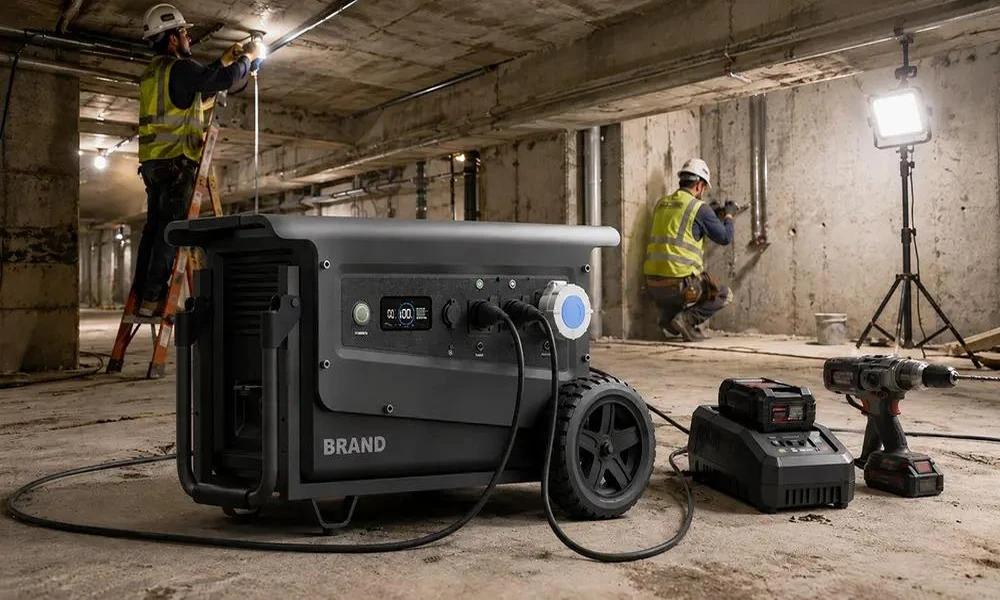
A home renovation is a peculiar workplace somewhere between construction site and homestead, and rarely very safe for electrical equipment. Circuits are dead for rewiring, and others are covered in temporary extension leads, and the load of corded tools is sometimes more than the average domestic circuit can stand. Add the usual accompaniments of dust, water and the occasional rain shower through an unfinished roof, and ordinary electrical gear can look somewhat fragile. This article introduces the essentials of a water-resistant, industrial-grade power station: what they are, what to watch for, and how to get the best from one.
What an Industrial Power Station Actually Is
A power station is a battery, inverter and charge controller combined in a single rugged case that features normal AC sockets, USB and often DC outputs without the need for fuel, fumes and a pull-cord. Most people will be familiar with the smaller camping versions that can charge a phone and run a lamp.
The industrial versions are built for serious use larger batteries, higher continuous output, more sockets and a robust outer casing to match, because they are intended for running corded tools rather than charging lightweight devices. You plug the power tool in just as you would at a wall socket and it should run as expected. Once the battery runs flat, recharge it from the wall, a vehicle or solar panels.
The main benefit of a renovation is that they are quiet and can be sited in the working area: there are no exhaust emissions to worry about and so they can cope with a half-finished room where a standard generator would be unsafe.
Why Renovation Sites Need Water and Dust Protection
Renovations are a damp and dusty affair a challenging combination for electrical goods. Tile-cutting uses water, floors can be washed and mixed mortar, plaster and screed are often prepared on site. An open roof can see a few days of bad weather and unheated rooms can hold condensation over the winter. Meanwhile, sanding drywall, cutting brick and removing old plaster all contribute to the fine dust that coats everything like a light dusting.
Dust is a greater threat than many people suspect. It clogs up cooling vents and fans, leading to equipment running hotter than it should, and when mixed with moisture leaves a fine film that can cause short circuits. A housing able to exclude dust and water spatter deals with both.
This is where the IP rating comes in handy, as a rating of IP54 means that there is limited ingress of dust (not completely dust-tight which would be IP6X) and protection against water spattered from any direction (but not immersion or continuous jets). It does not mean waterproof, it means splash-proof, so read the fine print when reading terms like ‘waterproof’ on large power stations.
What It Can Realistically Run
Before anything else, clarify what you need to power. Lights, phone-chargers, a router and computer are all light, a dehumidifier or fan is modest. Corded tools are where the figures climb: a circular saw may want around 1500 watts, a hammer drill around 1000, and an air-compressor can want more than that and have a hefty surge when its motor turns over.
A job-site unit has to be able to cope with surges as well as continuous output, which is why the specification usually gives both a rated output and a larger figure for the peak. If your heaviest tool only needs 3000 watts for a moment, a power station that can only manage 2000 will be frustrated.
Some units are designed with this in mind, the SOUOP Waterproof Industrial Power Station being one example, with a sealed enclosure and enough output to cover tools and not just phones and lights, though it may be worth comparing several against what you actually want to charge.
Reading the Spec Sheet
Now you’ve decided on what you need to power, the spec sheet makes a lot more sense.
Output. Look at both the continuous and peak ratings and make sure all the loads you plan to run add up to something less than the continuous. Capacity. Watt-hours is the measure of how long it will last. A rough calculation for run-time is capacity x 0.85 / load in watts, because inverters are not 100% efficient a 5000Wh battery running a 1000W tool will be able to run it for about four hours continuously. Tools rarely work flat out, though.
Battery type. LiFePO4 chemistries are the ones to look out for because they are good in hot conditions, and are generally more stable and longer-lasting than other lithium variants, often allowing 3000+ cycles.
Charging. How quickly it charges from the wall is very important too. If your working day ends at five and starts again at eight, it needs to be able to top up overnight. Solar charging is an added bonus on a worksite that has sun on it during the day but is otherwise without power.
Extras. Multiple sockets save the need for splitters, a UPS-style switchover allows computers or pump control systems to keep running during a black-out and expandable modules allow more power for longer jobs.
Placement and Safe Use
Even a well-protected unit will last longer in the right place. Mount it on a raised, level surface so that floor water cannot easily reach it, leave the vents clear and space around the unit to allow heat to escape freely. Avoid direct midday sun, and don’t run or charge it in freezing conditions, unless the manufacturer states it is suitable.
On wet worksites, use extension cords rated for the load and keep them short and off the floor where possible, and take outlets through a GFCI or RCD if available. Avoid plugging power stations into house sockets to feed the building’s systems as it can create a potentially dangerous back-feeding situation. And if you’re working on the electrical systems, make sure the circuit is isolated at the breaker, no matter what other power tools you may have.
Common Mistakes
There are a few recurrent mistakes. Buying based on watt-hours and not peak output, estimating the load of a tool rather than checking the spec, using thin or long extension cords that waste power and overheat, sitting the unit on wet ground because it’s water-resistant, running the battery flat every day and not investing in a larger unit, and forgetting that recharging takes hours and having a plan for overnight charging.
Choosing the Right Size
Start with your peak hour, the busiest period and list the tools that might be in simultaneous use: add the lights and any dehumidifier and allow for start-up currents, then factor in how many hours of work you want between charges. This gives you the output and capacity you need.
Workforces that regularly use multiple heavy tools tend to look at the 5000W class. The SOUOP Portable Power Station 5000W has a peak rating above continuous output for start-up currents and can be expanded upon with additional battery modules, but the right choice is informed by the tool list rather than any particular figure.
Final Thoughts
A renovation is an exercise in planning and power is often one of the areas that gets overlooked until it’s needed. A water-resistant, dust-tolerant power station provides reliable electricity in the messy part of the job, without the need for fuel and exhaust emissions. Reading the IP rating honestly, choosing a size that tackles peak loads and placing it sensibly will make the work from demolition to final paint job easier to complete.
