

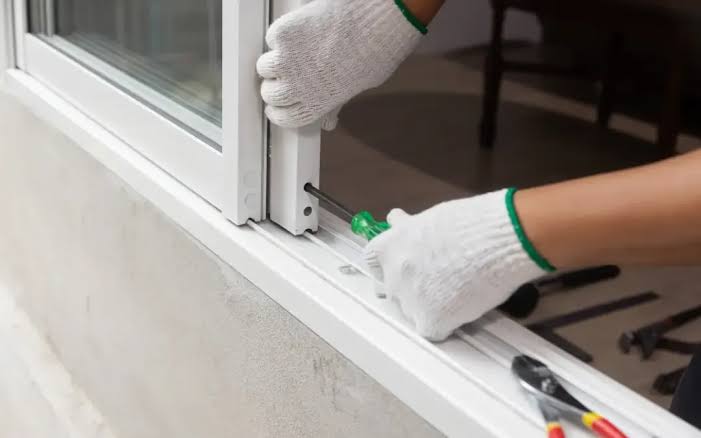
There is a wonderfully simple diagnosis for a patio door that has become difficult to open.
“It’ll need new rollers.”
Sometimes that’s exactly right.
Sometimes it isn’t even close.
Sliding doors are deceptive because the symptoms of several completely different faults can feel almost identical from the handle. The door becomes heavy, starts scraping or develops a rough patch halfway across the opening. Naturally, attention turns towards the wheels carrying all that weight underneath.
Replace them and everything should glide again.
Except there are plenty of occasions where perfectly good rollers get replaced and the door still doesn’t run properly.
The reason is fairly straightforward. Rollers are only one part of a much larger mechanical arrangement. A proper patio door repair means working out why the door has become difficult to move rather than automatically changing whichever component seems the most obvious.
Sometimes the problem is underneath the rollers.
Sometimes it’s around them.
And occasionally the door itself is telling you something about the building it sits in.
A sliding door is simple – until it isn’t
Compared with a bifold system, a traditional sliding patio door looks mechanically uncomplicated.
One large panel moves sideways along a track. Rollers underneath carry its weight. A locking mechanism secures it when closed.
That’s basically it.
But those few components have to remain properly aligned while carrying a considerable amount of glass.
Modern doors can be particularly heavy. Even older double-glazed patio panels aren’t exactly lightweight.
The rollers therefore need a reasonably straight, clean and properly supported surface to travel across.
Imagine fitting brand-new tyres to a car with badly damaged suspension and expecting the ride to become perfect.
Changing the tyres might help.
It hasn’t fixed the reason they wore unevenly in the first place.
Sliding doors can be similar.
The track matters as much as the rollers
This gets overlooked constantly.
Homeowners see rollers as replaceable mechanical parts and the track as simply a strip of metal underneath them.
But the running surface determines how those rollers behave.
Years of use can leave tracks damaged, worn or distorted. Dirt and small stones become trapped underneath heavy doors and are repeatedly crushed against the surface.
Eventually grooves appear.
Sometimes sections become flattened.
Occasionally the track is visibly damaged where a failed roller has effectively been dragged across it instead of rolling properly.
Put a new roller onto that surface and you haven’t restored the system.
You’ve put a good component onto a bad track.
It may initially feel better because the new roller moves more freely than the old one, but the underlying running problem remains.
Worse, a damaged track can start wearing the replacement roller prematurely.
Then six months later the homeowner understandably wonders why the repair didn’t last.
Listen to where the noise happens
Sliding doors give away quite a lot if you pay attention.
A rough roller often creates a fairly consistent unpleasant movement throughout the door’s travel.
Track damage can feel different.
There might be one particular point where the door catches or judders every time.
Open.
Judder.
Close.
Judder in exactly the same place.
That’s useful information.
If the problem consistently occurs at the same physical position along the track, you need to be looking at what the roller encounters there.
It could be track damage.
It could be contamination.
A small stone can create a surprisingly dramatic effect underneath a heavy glazed panel.
The temptation is to force the door past it repeatedly.
Which tends to turn a small problem into a more expensive one.
Dirt does more damage than it gets credit for
Patio door tracks live in a terrible location.
They’re right on the boundary between house and garden.
Every bit of muck seems to find them eventually.
Dust. Soil. Dog hair. Tiny stones. Leaves. Dried mud. Bits of gravel. Debris carried in on children’s shoes.
A family that uses the patio entrance constantly during summer can put the rollers through this mixture dozens of times every day.
It acts like an abrasive.
One of the more questionable homeowner fixes is to spray lubricant over the lot.
The door feels slightly better temporarily, so the job appears successful.
Meanwhile the lubricant combines with the existing contamination and produces a sticky mixture that traps even more debris.
There is a place for appropriate lubrication.
There is also a time for a vacuum cleaner and a brush.
The second option is considerably less exciting but often more useful.
New rollers can’t straighten a crooked frame
This is where diagnosis gets more interesting.
A sliding door may become difficult because the frame itself is no longer sitting as squarely as it once did.
Buildings move.
Usually by tiny amounts.
Extensions settle. Older properties shift fractionally through seasonal changes. Structural openings can alter enough over years to affect something as alignment-sensitive as a large glazed door without there being any dramatic structural problem.
The difference might only be a few millimetres.
For a patio system, a few millimetres matter.
If the frame is slightly distorted, the door may be running unevenly even though the rollers themselves remain serviceable.
You can replace them.
The new ones will still be travelling through the same geometry.
This crops up particularly in older housing and properties that have been extended or substantially altered.
Sometimes the door is blamed for a problem originating elsewhere.
Adjustment is part of the diagnosis
Rollers on many sliding doors can be adjusted.
That isn’t simply there to make the panel sit at whatever height looks nicest.
Adjustment helps the door sit squarely within the frame, move correctly across the track and meet the locking side properly.
Get it wrong and strange things happen.
One side carries more weight.
The lock becomes difficult to engage.
The door can appear to have a failed roller when actually it is badly adjusted.
This is one reason random screwdriver adjustments aren’t always helpful.
People understandably search online, find an adjustment screw and start turning.
The door rises.
Great.
Except now the opposite corner doesn’t line up properly with the lock.
So another adjustment gets made.
Eventually nobody remembers where anything started.
You can chase alignment around a sliding door for quite a while like that.
A locking fault can masquerade as a movement problem
Here’s another one.
Sometimes the door slides reasonably well until the last few centimetres.
Then it becomes difficult.
That doesn’t necessarily point towards rollers at all.
The problem may sit within the locking side of the system.
A misaligned keep, worn locking strip or dropped panel can create resistance as the door approaches its closed position.
To the person using it, the whole door simply feels stiff.
This is why describing exactly when a problem happens is useful.
Heavy throughout the entire movement?
Rough in one particular place?
Fine until nearly closed?
Difficult only when operating the handle?
Those are different symptoms.
They point in different directions.
A lot of UPVC mechanism repairs begin with separating the component that finally complained from whatever caused the strain in the first place.
Replacing parts without doing that can become an expensive guessing game.
Sometimes the old rollers really are finished
None of this means rollers don’t fail.
They absolutely do.
Older patio systems can contain running gear that has carried heavy glass panels for fifteen or twenty years.
Bearings wear.
Wheels become damaged.
Adjustment mechanisms corrode.
Some rollers seize almost completely.
There comes a point where cleaning and adjustment won’t achieve much because the component has reached the end of its useful life.
The difference is diagnosis.
If worn rollers are the cause, replacement makes sense.
If worn rollers are the consequence of a damaged track or poor alignment, replacing them without addressing the other issue only completes half the job.
That distinction matters.
Especially with older systems where compatible parts are becoming harder to source.
Parts availability is becoming a bigger issue
This is one of the less glamorous realities of repairing older UPVC and aluminium doors.
The original manufacturer may no longer make the hardware.
The roller design might have changed.
The company that supplied the door could have disappeared years ago.
A homeowner might know who installed the system but have absolutely no idea who manufactured the running gear underneath it.
Then the detective work starts.
Measurements matter.
Profiles matter.
Wheel dimensions, fixing positions and adjustment arrangements matter.
Sometimes compatible replacements exist from another manufacturer. Sometimes an older component can be matched with a modern alternative.
Occasionally the exact part is simply obsolete.
This is another reason throwing replacement components at a problem before understanding it properly isn’t sensible.
If original hardware is difficult to source, you don’t want to replace serviceable parts unnecessarily.
The weight of modern glass changes the equation
There is also a broader trend worth mentioning.
We keep making doors bigger.
Homeowners want wider openings, larger panes and slimmer frames. Architects want uninterrupted garden views. Extensions increasingly use glazing as a major architectural feature rather than simply somewhere to put a door.
Looks great.
But somebody still has to carry the glass.
On a sliding system, much of that work happens through relatively small pieces of running gear underneath.
The heavier the panel, the more important track condition and alignment become.
A tiny obstruction underneath a lightweight cupboard door is annoying.
Put a similar obstruction underneath a large glazed patio panel and the forces involved are completely different.
That is why repeatedly dragging a heavy door across a damaged section of track can create surprisingly rapid wear.
A door becoming heavy gradually is easy to miss
This might be the biggest reason sliding door faults get left for so long.
They rarely go from effortless to unusable overnight.
The change is incremental.
You pull slightly harder this month.
A little harder next year.
Eventually opening the patio door requires a deliberate lean backwards and both hands.
But because everyone in the house has adapted gradually, nobody thinks much of it.
Then a visitor tries to open the door.
“What’s wrong with this?”
Nothing.
It’s always like that.
That sentence should probably be printed on half the repair invoices in Britain.
A properly operating sliding door shouldn’t require a workout.
Large panels have weight, obviously, but the running gear exists specifically to manage it.
When effort increases noticeably, something has changed.
The repair-versus-replacement question comes too early
Another pattern is homeowners jumping straight from “my patio door is stiff” to “how much is a new patio door?”
That’s quite a leap.
Frames and glass can remain perfectly usable long after mechanical components start causing trouble.
Rollers are replaceable on many systems.
Locks can often be repaired.
Alignment can be corrected.
Certain track problems can be addressed without removing an entire door installation.
There are obviously cases where replacement is sensible. Badly distorted frames, serious structural problems, extensive damage or systems for which nothing compatible can realistically be sourced.
But stiffness alone isn’t enough to condemn a patio door.
This has become particularly relevant as household renovation budgets have tightened.
Repairing the mechanical fault rather than replacing several square metres of perfectly good glazing is increasingly the first question homeowners ask.
Fair enough.
The best repair can involve fewer new parts
There is something satisfying about replacing a visibly broken component.
Old part out.
Shiny new part in.
Problem solved.
Real repair work isn’t always that tidy.
Sometimes the correct answer is cleaning a track thoroughly, correcting alignment and adjusting existing rollers that still have plenty of life left.
Not exciting.
No impressive pile of failed components to show the homeowner afterwards.
But if the door glides correctly again, that’s the point.
Conversely, there are jobs where rollers clearly need replacing but doing only that would be poor practice because the track damage that destroyed them remains underneath.
Good diagnosis sometimes means fitting more parts.
Sometimes fewer.
Check the whole journey of the door
If a sliding door has started becoming troublesome, it is worth observing exactly what happens rather than simply deciding it “needs rollers”.
Open it slowly.
Does resistance remain constant?
Does the door become heavier at one particular point?
Can you hear grinding?
Does one corner appear lower?
Does the problem only occur when closing?
Does the handle feel stiff even when the door itself moves reasonably well?
Look at the track too.
Obvious scoring, compacted dirt and damage are worth noting.
Don’t start dismantling anything based on those observations. A large glazed panel is not something to casually remove after watching a two-minute tutorial.
Just pay attention.
The behaviour usually provides clues.
And avoid the instinct to compensate with more force.
Sliding doors usually give plenty of warning
Complete failures feel sudden because that’s the moment the door stops cooperating.
The deterioration beforehand often wasn’t sudden at all.
There was the occasional scrape.
Then the stiff patch.
Then the handle started needing a bit more effort.
Maybe somebody mentioned that the door didn’t seem to sit quite straight anymore.
Months pass.
Eventually a roller collapses, the mechanism jams or the door becomes too heavy to move normally.
At that point, new rollers may indeed form part of the repair.
They just shouldn’t automatically be the diagnosis.
A sliding door is a system. Track, rollers, frame, locks and alignment all affect one another.
Replacing the obvious moving part without checking the surface it runs on and the structure holding everything square is a bit like buying new shoes because you’ve started limping.
Sometimes the shoes were the problem.
Sometimes you need to look a little higher up.
