

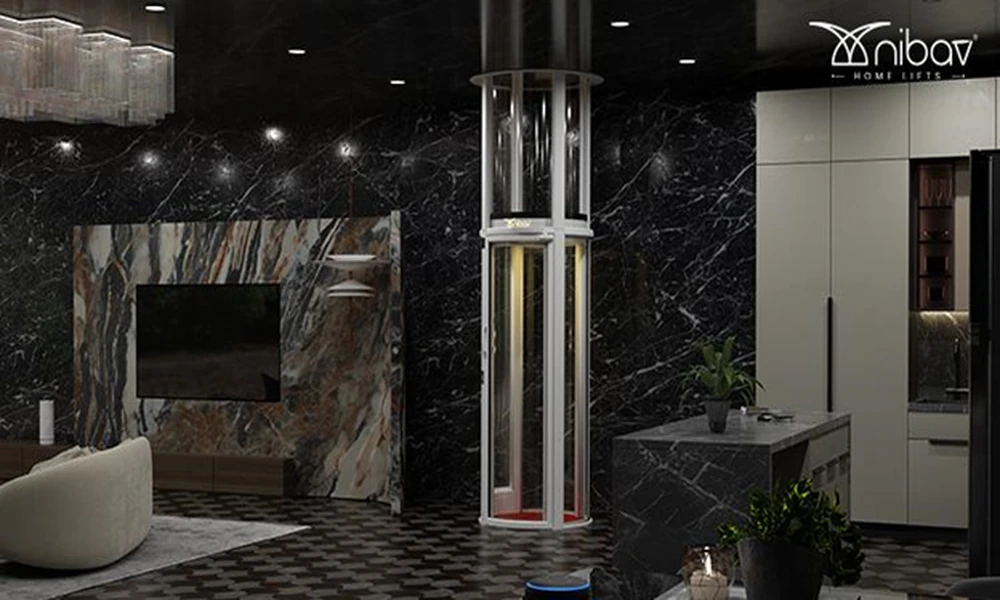
Introduction: The energy question behind every home lift
Adding a home elevator can solve a very real problem: stairs become inconvenient when a home has multiple floors, family members have mobility needs, or everyday tasks involve carrying groceries and household items between levels. But homeowners often hesitate because they assume an elevator must consume substantial electricity every time it moves.
That concern is understandable. Conventional elevator systems can use motors, cables, pumps or other mechanical components that make energy consumption an important part of ownership. When the lift is used several times a day, the question is no longer simply, “Can I install one?” It becomes, “How much energy will it use over years of daily living?”
This is where energy efficient home elevators take a different approach. Pneumatic vacuum elevators use air pressure to move the cabin, and Nibav’s Malaysia range is designed to draw power primarily during ascent while using air pressure for descent. The result is a different operating profile from many conventional systems, alongside a compact, self-supporting design intended for Malaysian homes.
Why energy efficient home elevators matter for modern homes
Energy efficiency is not only about the electricity bill. It is also about choosing technology that matches how a residential product is actually used.
A home elevator is typically a short-distance, low-frequency mobility system. It does not need to behave like a commercial lift serving hundreds of people every hour. For homeowners, the more useful questions are whether the system can provide reliable movement between floors, how much power it needs during normal operation, and whether the installation creates unnecessary construction and maintenance demands.
For this reason, homeowners comparing home elevators in Malaysia should look at the complete operating picture:
· How the lift moves
· When electricity is consumed
· Whether the system needs a separate machine room
· Whether it requires a pit or heavy civil work
· How much space the installation occupies
· What maintenance the technology requires
· Whether the cabin and controls suit everyday family use
Nibav positions its air-driven home lifts as energy-efficient and eco-friendly. Its Malaysia site states that the lifts operate on a regular 3.7 kVA power supply, draw power to ascend and zero power to descend. That distinction is central to understanding how pneumatic vacuum technology approaches energy use.
For homeowners in Kuala Lumpur, Selangor, Johor, Penang and other parts of Malaysia, this can be especially relevant when a lift is being considered for an existing home rather than a new construction project.
How pneumatic vacuum elevators use energy differently
A pneumatic vacuum elevator works by creating a pressure difference around the cabin. Rather than relying on a conventional cable-and-counterweight arrangement, the system uses air pressure to control vertical movement.
The important point for homeowners is that the system does not need electrical power in the same way for every part of the journey. Nibav describes its technology as drawing power while ascending and using air pressure for a natural, energy-saving descent.
That operating pattern can be useful for a residential application because a journey between floors is relatively short. If a family uses the lift repeatedly throughout the day, the distinction between powered ascent and non-powered descent becomes part of the overall energy profile.
There is another benefit to the pneumatic approach: the design can be compact. Nibav’s home lifts are self-supporting and designed without a traditional pit or separate machine room. This can reduce the amount of construction associated with adding a lift to an existing property.
Energy efficiency should still be considered alongside the complete specification. Homeowners should not choose an elevator on one energy claim alone. Capacity, number of stops, installation requirements, safety systems, usage patterns and service requirements all matter.
Who is most likely to benefit from an energy-conscious home lift?
The target audience is broader than people who simply want to reduce electricity use.
1. Families in multi-storey homes
Duplexes and villas often have everyday movement between floors. A home lift can make that movement more convenient while an energy-conscious system helps homeowners think about long-term operation.
2. Older family members
Malaysia is moving into an ageing-society phase, and home design is increasingly being discussed around ageing in place and independence. Research and home-modification initiatives in Malaysia highlight the importance of making homes safer and more accessible for older adults.
3. Homeowners renovating an existing property
A system that does not require a conventional pit or machine room can be more practical when the home is already finished.
4. Design-conscious homeowners
Energy efficiency does not have to mean compromising on appearance. Modern vacuum home lifts can combine transparent cabins, compact footprints and customized finishes.
5. Homeowners comparing long-term ownership costs
The purchase price is only one part of the decision. Energy use, maintenance, installation and the amount of home modification required should all be considered.
Malaysia has a substantial base of owner-occupied homes: DOSM reports that household ownership of living quarters reached 78.0% in 2024, while urban ownership reached 75.0%. That makes long-term home improvements particularly relevant for homeowners who intend to stay in their properties.
Why Nibav home lifts in Malaysia fit the energy-efficiency conversation
Nibav’s Malaysia range is built around air-driven vacuum technology, with the brand emphasizing energy efficiency, compact installation and low-maintenance operation.
The Series III Standard, for example, is positioned as a compact air-driven home elevator for small and medium villas, duplexes and multi-storey homes. The model requires approximately 1010 mm of clear space, has a 210 kg capacity and can serve up to four stops (G+3). Nibav states that its Series III Standard uses power during ascent and air pressure for descent.
Across the wider Malaysia range, the brand also emphasizes no pit, no machine room and a self-supporting structure. These characteristics matter because energy efficiency is more meaningful when considered alongside installation and ownership. A lift that fits into an existing home with less structural intervention may offer a different overall value proposition from a conventional system that requires a dedicated shaft and machinery space.
Nibav also offers larger models for homeowners who need more cabin space. Series V and Series V Max are positioned toward more spacious and premium residential applications, with Series V Max offering a larger cabin and higher capacity.
| Nibav Malaysia consideration | What it means for homeowners |
| Air-driven operation | Uses pneumatic technology rather than a conventional hydraulic or traction arrangement |
| Power profile | Nibav states power is used for ascent and zero power for descent |
| Installation | Designed without a traditional pit or separate machine room |
| Space | Compact, self-supporting designs can suit existing homes |
| Range | Series III, IV and V families provide different size and capacity options |
| Customisation | Multiple finishes, colours and design options are available |
Choosing the right energy efficient home elevator in Malaysia
The best home elevator is not necessarily the one with the lowest headline energy figure. It is the one that fits your home, usage and future needs.
Start by measuring the available space. Nibav’s Series III Standard requires 1010 mm of clear space, while larger models such as Series V Max require substantially more. Capacity is equally important: a compact model may suit a small family, while a larger model can be more appropriate where wheelchair access, attendants or frequent multi-person use are priorities.
Next, consider installation. A pitless, machine-roomless design can be particularly relevant to existing Malaysian homes because it avoids some of the major construction requirements associated with conventional elevators. Nibav states that prepared-site installation can typically be completed in 4 to 5 working days, depending on the model and site conditions.
Finally, evaluate safety and service. Energy efficiency is valuable only when the lift is also designed for safe daily family use. Nibav’s systems include features such as emergency descent, door safety systems, overload protection and backup provisions, with TÜV NORD certification highlighted across its Malaysia materials.
Frequently Asked Questions
1. Are pneumatic vacuum elevators energy efficient?
They can be highly energy-conscious because the operating cycle can be designed to use electricity for ascent while using air pressure for descent. Nibav states that its home lifts use power during ascent and zero power during descent.
2. Do energy efficient home elevators need a machine room?
Not necessarily. Nibav home lifts are designed as self-supporting systems that do not require a separate machine room or traditional pit.
3. Are Nibav home lifts suitable for existing homes in Malaysia?
Yes. The Malaysia range is specifically positioned for existing homes, renovations, duplexes and villas where major structural work may be impractical.
4. Which Nibav model is best for a compact Malaysian home?
The Series III Standard is positioned as a compact option, with a 1010 mm clear-space requirement and a 210 kg capacity. A site assessment is still important before selecting a model.
5. Does energy efficiency mean a home lift has to compromise on design?
No. Nibav combines air-driven technology with panoramic cabins, multiple finish choices and model-specific design features, allowing homeowners to consider efficiency and aesthetics together.
