

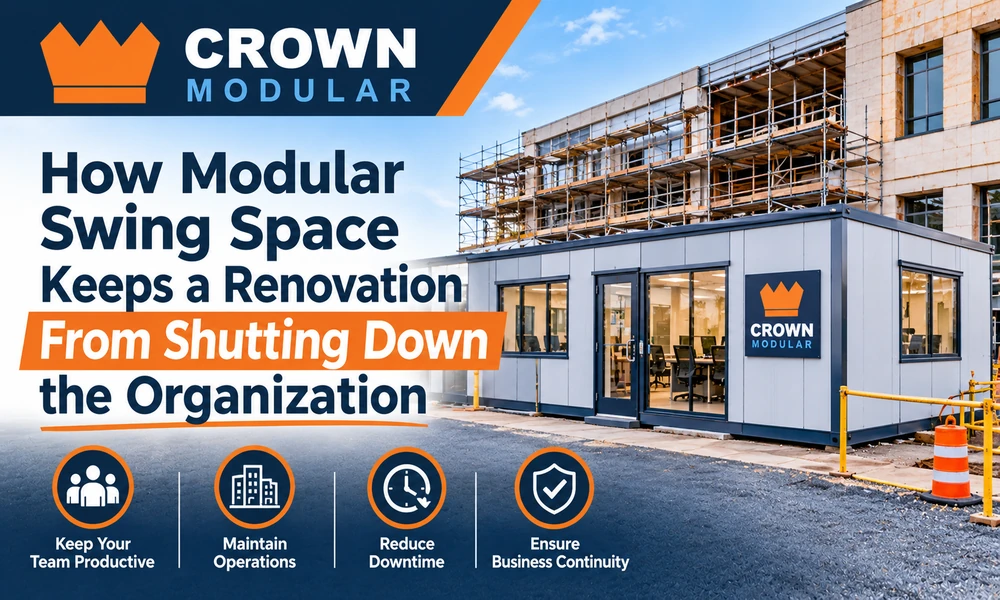
Renovating an occupied building asks two projects to share the same address. Contractors need access, noise and room to work. The organization still needs offices, classrooms, treatment rooms or public services. Trying to keep everyone in place can slow construction and make every workday harder. Moving the entire operation offsite can be just as disruptive.
Modular swing space creates a third option. A temporary building can move one department, grade level or function out of the construction zone while keeping it close to the main operation. The existing building gains room for the work to proceed, and employees or students get a setting designed for more than a few improvised weeks.
Move the function that unlocks the renovation
The best swing-space plan does not always move the largest group. Sometimes relocating administration opens a clean path for an entire wing. In a school, moving a cluster of classrooms may let contractors complete one phase instead of working around students room by room. In a clinic, shifting nonclinical offices can free the quieter area needed for temporary patient services.
Start by mapping who must remain near the main building and what they need to do. Then define the rooms, storage, restrooms, technology and accessibility required in the temporary facility. Crown Modular’s modular office buildings can be configured around different working arrangements rather than simply providing an open shell.
Treat the move-in date as part of the construction schedule
Site preparation and factory work can proceed at the same time, but only when the information is coordinated. Foundations or supports, utilities, data, entrances and permits all affect occupancy. Furniture and technology should be ready before the department moves. If the temporary building opens late, the renovation either waits or begins with people still in the way.
Duration influences whether rental, lease or purchase makes sense. A one-year renovation may support a rental with a clear return plan. A multi-phase program or future growth need may justify keeping the building longer or relocating it elsewhere. Price a realistic extension, because construction schedules can change after walls are opened and inspections begin.
“The temporary building should feel like part of the organization, not a place people have been sent away to,” said James Webb, Company Director at Crown Modular. “If the route is awkward, the rooms do not support the work or the technology is unreliable, employees feel every compromise.” We plan swing space around the same daily needs that would guide a long-term facility, while keeping the future move in view.
That attitude changes the result. A school can keep classes together instead of scattering them wherever a room is open. A clinic can protect privacy. An office team can continue meeting customers without talking over demolition noise. The building is temporary, but the work and the people doing it are not. They deserve space that lets the organization keep its promises during construction.
Once the renovation is complete, furniture and systems can move first while the swing building remains available for the last corrections.
Our modular building buyers guide helps owners see how the building, site and daily operation come together. That is especially valuable for swing space because temporary should not mean improvised. The building still needs a clear plan, a safe path to occupancy and an exit strategy. Done well, it gives contractors the freedom to renovate properly while the organization continues serving people a few steps away.
By James Webb, Company Director at Crown Modular
